

Part 2: Pounds
The pound didn’t start as a scientific invention.
It started as a survival tool.
Back when markets were loud and roads were slow, people needed a shared way to trade “how much” of something grain, wool, iron, salt. The pound became a familiar promise: this is a fair amount. Not perfect just good enough to keep commerce moving.
The problem was, for a long time, there wasn’t one pound.
There were many. Different regions carried different “pounds,” and what counted as fair in one place could be a quiet scam in another. Over time, the British world pushed toward a dominant everyday standard: the avoirdupois pound the pound most people mean today in the U.S. and much of industry.
Then the modern era arrived, and modern engineering demanded a brutal upgrade: exact definitions.
So, the pound stopped floating in history and got chained to the metric system with an iron link:
1lb = 0.45359237 kg exactly
That number isn’t approximate. It’s law-level exactness. The pound today exists as a defined fraction of the kilogram a legacy unit now anchored to SI precision. (U.S./international standards lock this relationship.)
And that’s the first twist in the story:
The pound survives culturally, but it lives scientifically inside the kilogram’s house.
So yes, pounds measure something real: mass. Inertia. The same “how hard it is to accelerate” concept the kilogram measures.
But then gyms happened. And everyday language happened. And the pound developed its identity problem.
Because most people don’t use “pounds” like physicists do.
They use “pounds” like a feeling.
They say “this weighs 50 pounds,” meaning the pull downward which is a force.
And force is not mass.
That’s where the second twist hits:
The Pound’s Big Confusion: lb vs lbf
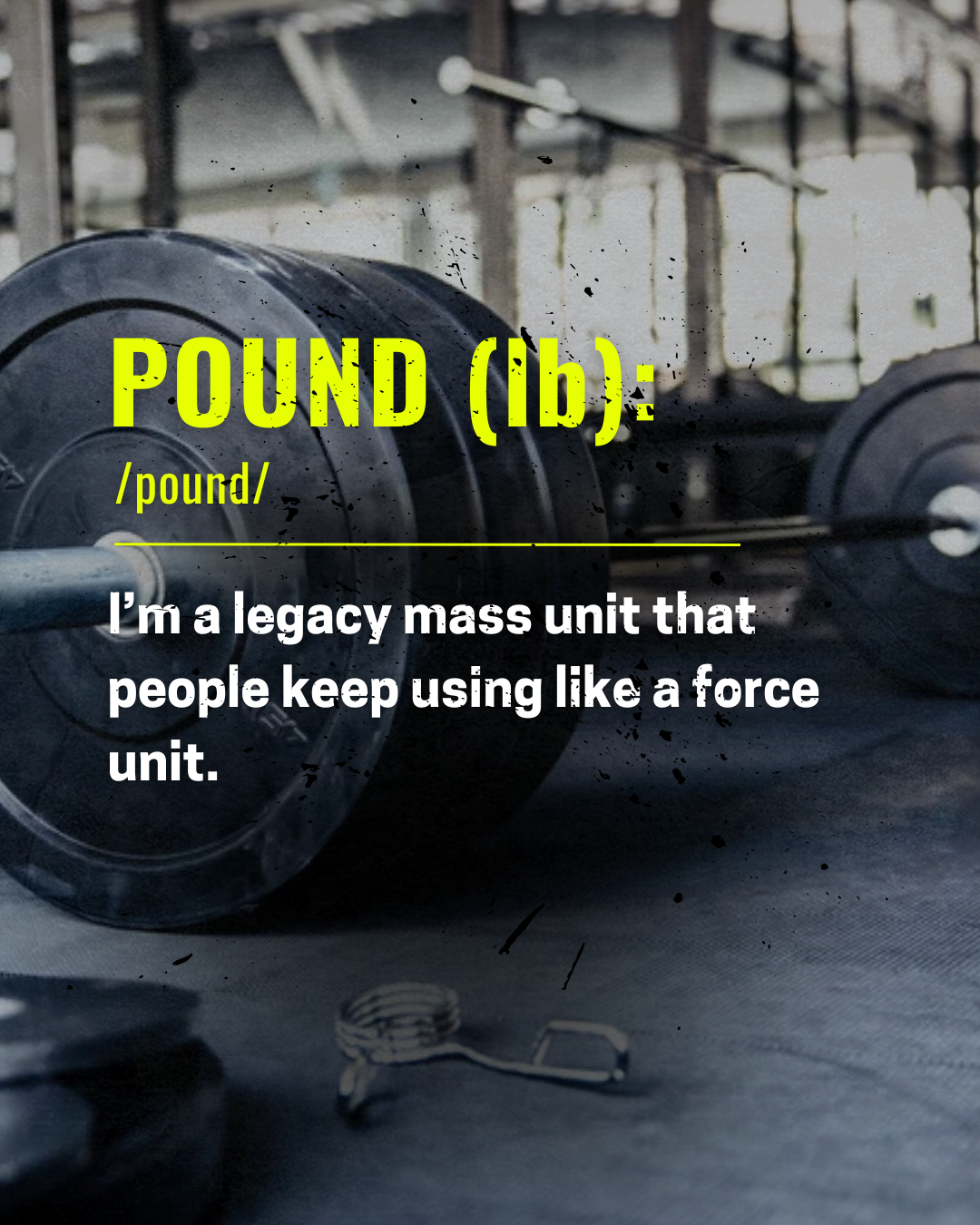
In science and engineering, people had to split the pound into two different creatures to stop the madness:
- lb (pound) = mass (avoirdupois pound-mass in common usage)
- lbf (pound-force) = force, defined as the weight (force) of 1 lb mass under standard gravity
- Kilograms and pounds are great at mass.
- But if you want “true load,” “true force,” and a clean language for progression and power, you need a unit that doesn’t depend on Earth’s gravity to be meaningful.
That last part matters: pound-force is built on gravity. NIST explicitly defines pound-force in terms of the weight of a one-pound mass at standard gravity, and points out that the SI force unit is the newton.
So in a way, pounds “work”… until you ask them to be honest about force.
Because the moment you leave Earth, or the moment you want a definition that doesn’t secretly assume a planet, the pound-force starts to look like a workaround.
It’s not that pound-force can’t be used it’s that it isn’t universal by design. It bakes in a specific gravitational reference. It’s force with an asterisk.
And that’s the theme we’re building toward:
That unit is waiting in Part 3.
Because when physics wants force, it doesn’t ask culture.
It asks acceleration.
It asks newtons.